
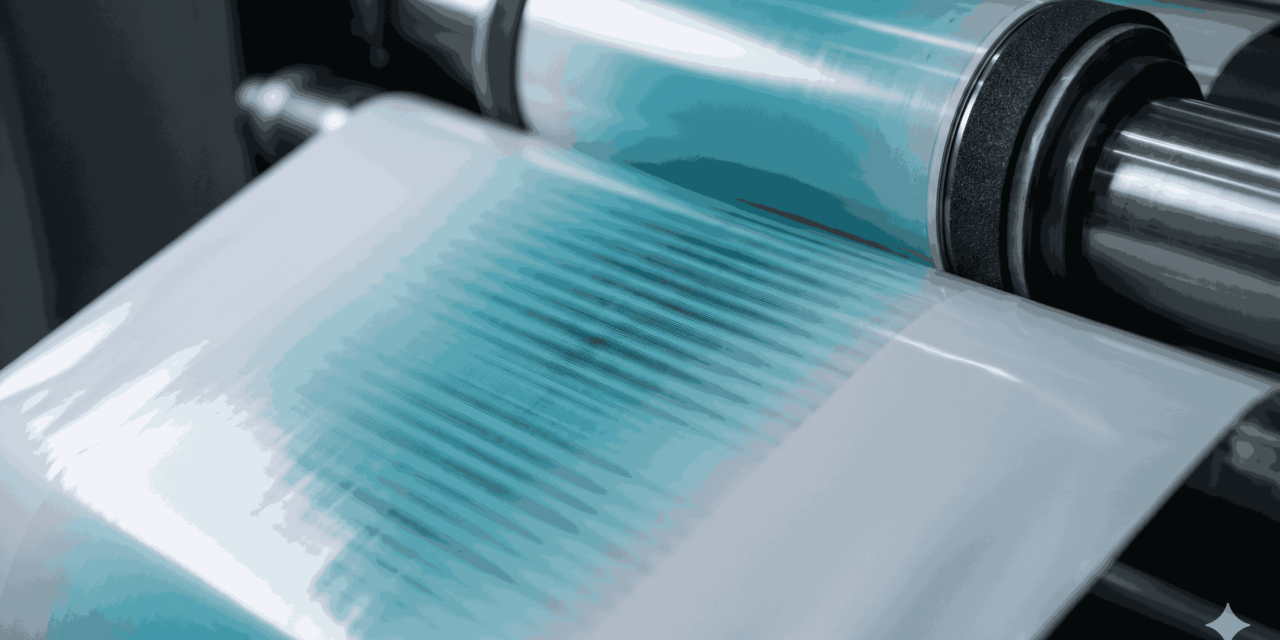
Ask a pressroom what causes those alternating light and dark bands marching across a screen, and most operators will reach for the same answer: gear marks, at least on those presses which still have gears and no servo drive. They check the gears, find nothing obviously wrong, fine-tune the impression, and the defect clears for a shift before drifting back. That moving-target behaviour is the tell. What you are chasing is usually not the gears at all. It is bounce, a self-sustaining vibration that builds up in the mounting stack as the plate enters and leaves impression hundreds of times a second. Treat it as a gear problem and you will keep losing the shell game. Treat it as a resonance problem in the tape, plate, and cylinder system and it becomes diagnosable.
What Bounce Actually Is
Bounce is a harmonic vibration. Every time a raised plate element strikes the substrate at impression, it delivers a small impact. The plate compresses, the mounting tape compresses beneath it, and both recover before the next impact arrives. At low speed this loading and unloading is harmless. As web speed climbs, the impacts arrive faster, and if their frequency lines up with a natural frequency of the mounted assembly, the oscillations stop damping out and start reinforcing each other. The plate begins to skip rather than kiss, alternately over-impressing and under-impressing as it rings.
The printed result is banding: bars of heavy and light ink density running perpendicular to the web, most visible in vignettes, tints, and mid-tone screens where small density swings are obvious. It is frequently grouped with gear marks and chatter because the three look almost identical on the web. The distinction matters because the fixes are different.
- Gear marks originate in the gear train. Worn teeth, wrong pitch, or backlash force a periodic speed mismatch between cylinders.
- Chatter is typically a doctor blade phenomenon, the blade vibrating against the anilox.
- Bounce lives in the mounting stack and is governed by stiffness, speed, and impression, not by the gears.
A worn gear and a bouncing plate can both produce bars of the same pitch, which is exactly why bounce gets misdiagnosed. The difference is that bounce responds to changes in mount stiffness and impression pressure, while a gear fault does not.
Why the Tape, Plate, and Cylinder Behave as One System
The plate does not bounce on its own. It bounces as part of a stack: the cylinder or sleeve at the bottom, the mounting tape in the middle, the plate on top. Each layer contributes stiffness and damping, and the combination has its own resonant behaviour. Get the combination wrong and you build a press station that wants to ring.
Three properties of that stack drive the problem.
- Mounting tape hardness. The foam is a spring with built-in damping. Too soft, and the plate sinks and rebounds excessively, feeding the oscillation. Too hard, and the foam transmits the impact instead of absorbing it, so vibration passes straight through to the plate. Foam compression behaviour is commonly specified in the region of 5 to 500 kPa, and matching it to the job is the single most effective lever you have over bounce.
- Plate hardness and relief. Hard, thin plates used for fine work resist deflection but ring more readily. Deep relief and isolated raised elements concentrate impact on a small contact area, raising the local force and making bounce worse. Solids and large coverage distribute the load and tend to bounce less.
- Cylinder or sleeve runout. Total Indicated Runout (TIR) on the plate cylinder, anilox, or impression cylinder injects a once-per-revolution disturbance. If TIR is excessive, the stack is being driven into oscillation mechanically before tape choice even enters the picture. TIR is best checked with a dial indicator before the plate goes on, since a bent journal or worn bearing will defeat any tape selection.
[insert image: cross section of the mounting stack showing cylinder, mounting tape, and plate with impact forces at the nip]
Reading the Web to Confirm Bounce
Before changing anything, confirm you are actually dealing with bounce rather than a gear or bearing fault. The printed web and a few press-side checks will tell you.
- The pattern responds to speed. Bounce is speed-dependent. If the banding appears or worsens at a particular press speed and eases when you run faster or slower through it, you are looking at a resonance, not a fixed mechanical defect. Gear marks track with the gears regardless of speed.
- The pattern responds to impression. Back the impression off towards a true kiss and watch the bars. Bounce typically eases as excess impression comes out. If the bars are unchanged by impression, suspect the gear train or a cylinder cut.
- The pitch is regular but not gear-pitched. Measure the band spacing. A spacing that matches a known gear tooth pitch points at gears. A spacing that shifts with speed points at bounce.
- It is intermittent. A bearing or journal fault tends to be steady and repeatable. Bounce that comes and goes between jobs, or appears only on certain plates, is pointing at the mounting stack and the artwork on the plate.
A hand-held stroboscope is the cheapest diagnostic worth owning here. Set it to the suspect frequency and a vibrating component will appear to stand still, letting you locate undesired harmonic resonance on a running press without stopping production.
Fixing and Preventing Bounce
Bounce is corrected by retuning the stack and the impression, not by forcing the press. Work through the cheap, reversible changes first.
- Reduce excess impression. Over-impression is the most common cause and the easiest fix. Precision elastomer sleeves and well-made photopolymer plates need only a kiss impression. Operators carrying habits over from heavier traditional setups routinely run far more impression than the job requires, which loads the stack and drives bounce.
- Match the mounting tape to the artwork. Move to a harder foam for solids and heavy coverage to keep the plate from sinking and rebounding. Move to a softer or mid-soft foam for fine screens and process work to damp the impacts. This is where tape selection pays for itself.
- Check and correct TIR. Verify runout on the plate cylinder, sleeve, anilox, and impression cylinder with a dial indicator. Replace worn bearings and bushings. No tape can compensate for a bent cylinder.
- Inspect the plate itself. Confirm proper relief, full washout, and adequate main and back exposure. A plate with shallow or uneven relief, or one that is too soft for the job, will misbehave in the nip. Look for cuts or nicks in the cylinder surface, which print as fixed bounce marks.
- Distribute the load where you can. At the prepress stage, microcell or surface-patterning the plate and avoiding isolated heavy elements next to fine screens reduces the impact concentration that triggers bounce.
Common Pitfalls to Avoid
- Adding impression to “push through” the bars. More impression almost always feeds bounce rather than curing it, and accelerates plate and anilox wear.
- Replacing gears on a hunch. Confirm the defect is gear-pitched and speed-independent before touching the gear train.
- Treating tape as a fixed choice. The same press running solids and process work on different jobs may need different foam grades. One universal tape is a compromise that invites bounce on the jobs it does not suit.
- Mounting over an unchecked cylinder. TIR and surface damage should be ruled out before the plate goes on, not after a shift of waste.
Conclusion
Bounce is the defect operators most often misname. It looks like gear marks, gets blamed on gears, and survives every gear adjustment because its real home is the mounting stack. The plate, the tape, and the cylinder behave as a single spring-and-damper system, and when its natural frequency lines up with press speed, the plate starts to ring. Diagnose it by watching how the bars respond to speed and impression, confirm the mechanical basics with a dial indicator and a stroboscope, then retune the stack: kiss impression, the right foam hardness for the artwork, sound cylinders, and a properly made plate. Get the stiffness of the stack matched to the job and the speed you run, and the bars disappear for good rather than for a shift.